
By Byron Mutingwende.
The European Union (EU) Council unanimously agreed to lift appropriate measures under the Cotonou Agreement Article 96 that were imposed against the government of Zimbabwe.
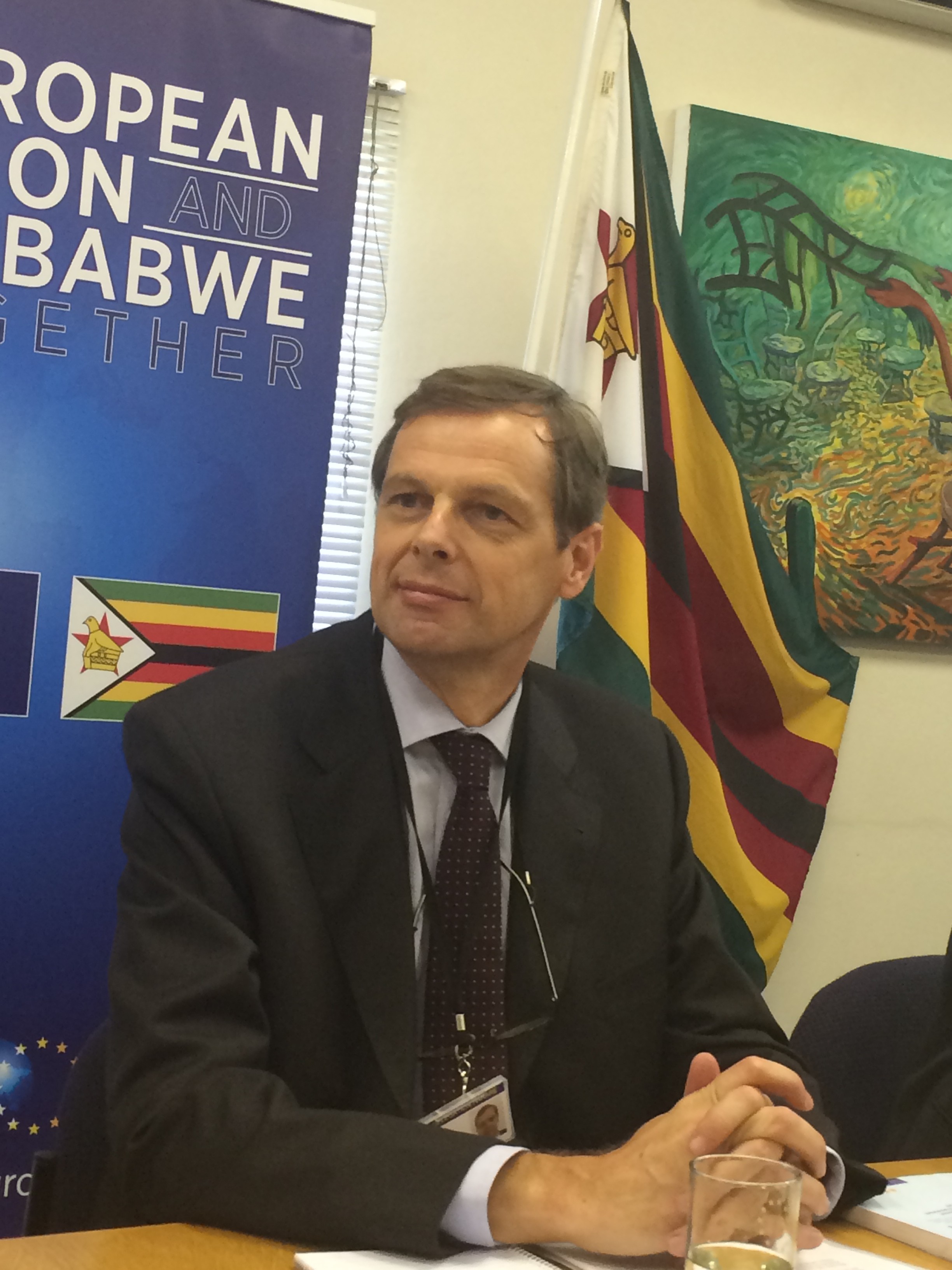
Addressing a press conference on the latest developments on EU-Zimbabwe relations, Phillippe Van Damme, head of the EU delegation to Zimbabwe said the bloc had agreed to lift the appropriate measures in order to resuscitate direct engagement with the Zimbabwean government and forge ahead with political, trade and development partnerships.
On the development aspect, African-Caribbean Pacific and European (ACP-EU) relations enabled ACP countries to have privileged access to European markets. Damme said in 2009, Madagascar, Mauritius, Seychelles and Zimbabwe signed the Lome convention.
The Lomé agreements lay down the framework for cooperation on development policy, economic policy, trade and industry between the EU and ACP countries.
The appropriate measures are related to the development cooperation side. The restrictive measures limited individual and entities’ on travel and trade in European countries. The EU ambassador added that Article 9 defines essential elements regarding democracy, rule of law and human rights.
Appropriate measures on Zimbabwe had seen the EU cooperate with multilateral organisations, non-governmental organisations and civil society organisations in the social sectors of health and education through project driven approaches focusing on direct support of the ordinary populace.
Thus development aid was re-oriented towards the social sector in areas of democracy, human rights and rule of law.
Despite the existence of the appropriate measures, development co-operation continued to exist between Zimbabwe and the EU with the latter being one of the biggest bilateral donors to the country since it has provided over 1, 5 billion Euros from 2002 to date.
“The EU can now directly engage the government of Zimbabwe on political and policy issues. We will have a more programmed approach and pursue strategic sector based development cooperation and improve institutional capacity and encourage structural reforms,” Damme said.
The EU will also provide development funds for the period 2015 to 2020 for programmes focusing on governance, health and agriculture. It also supports the government’s adoption of International Monetary Fund (IMF) staff monitored programme.
The government’s commitment to constitutional re-alignment, protection of and upholding of human rights had influenced the EU’s lifting of Article 96 on Zimbabwe. The EU said it would also help Zimbabwe create conducive investment environment for a turnaround of the economy.