
By Natasha Justin
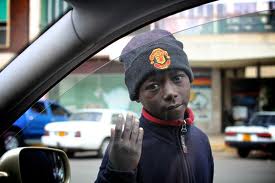
Fadzai (not her real name) aged eight is seen stopping each and every person who is walking along Harare’s First Street in the Central Business District (CBD) presenting her case by giving passersby a letter which one can hardly read because of fading ink on it which she interprets.
Dressed in her dirty and torn uniform one can hardly differentiate her from a street urchin.
Prescribed on the laminated letter she is carrying is a name of a local college which she says she attends with a signature signed on it requesting for money to pay out her fees.
She is supposed to be in grade three but she admits she has never been to school since she was born
“It is awful and shameful to beg, but I do not have a choice since my parents are of a poor background,” she says.
No matter how difficult or shameful it is, she has to beg because her mother who is blind forces her to go into the Central Business District to collect whatever she can get.
“This has become our source of livelihood, we survive through begging because my mother does not work,” she says.
Fadzai does not beg for money only but she also asks for food which puts her at food poisoning risk.
By nightfall she leaves to her family home, a Nyerere flat in Mbare area opposite Mupedzanhamo market stalls.
Despite having shelter they can call their own they still have to eat and pay bills, that being the major reason she is forced to beg.
Because of visual impairment her mother cannot do much to help the family, she chooses begging as survival strategy for her family.
“Since I am blind I cannot work for my children like any ordinary mother can do for her children and my husband deserted me for another woman, begging has become my survival strategy,” says the old lady.
On a good day Fadzai can get between $ 5 and $10 which is decent for her since it will help with the upkeep of her family.
This is almost the same case of every child begging in every busy part of Harare, these children can be regularly seen at traffic roads, in front of shops and public parks such as Harare Gardens and Africa Unity Square.
However the kids rarely keep the money for themselves as it is channelled towards family upkeep.
According to a report by Save the Children, a Child Human Rights Organisation (CHRO), child beggars are exposed to daily life and health risks and ultimately to risk of becoming victims of trafficking.
Save the Children adds that most of the child beggars are excluded from attaining primary education, the child beggars are being deprived with respect to all segments of their lives.
People who do business in First Street said this has become the life for so many children who beg in the popular street.
“We only see the kids begging, hardly know anything about their families and life except that they beg on a daily basis,” said Tinashe Chingizi a second hand phone dealer in First Street.
He added that there are no plans for the children to go to school since they are always in town every day asking for money.
Begging is a social occurrence, which is public and adversely visible.
International Labour Organisation (ILO) defines ‘begging’ as a range of activities whereby one individual asks a stranger for money on the basis of being poor.
Begging is the most present form of exploitation, which has serious consequences for the children’s behaviour and performances as they are exposed to child labour .
An airtime vendor who preferred to be identified as Amai Tinashe along First Street is of the idea that parents who force children to beg should be apprehended to the police.
“The future of children who beg is bleak, imagine what will become of them when they are old and have their own children to look for, it will be a disaster and the begging cycle will repeat,” she said.