
There tends to be an undeniable correlation between the availability and quality of social amenities and the well-being of residents of any community.
By Panashe Chikonyora
So imagine being a member of a ‘vacuum community’ where no social amenities exist or any other development takes place; an environment where self-interest is more important than selflessness.

Clearly life will always be difficult for one to survive or live in such a community, as most basic human rights such as the right life which is supported the right to become dignified through education are infringed.
Hence, there is need for social support in the form of education, water and food assistance, health care and many other contributions from both community members together with local and foreign investors to enable the development and proper functioning of a country’s most backward and stagnant communities, especially rural communities.
Developing communities start with the proper channels of communication and in order for that communication to penetrate remote areas there is need for the country to implement proper construction of roads and other services that give room for adequate social service delivery to take place. If these rural communities are less developed, chances of the country’s economic progress are reduced.

According to the World Bank Zimbabwe’s total rural population was reported at 67, 8 percent in 2019, a 1,43 percentage increase from 9 788 355 in 2018 to 9 928 163. Showing that rural areas constitute a greater part of the country’s population compared to urban areas, hence if they remain underdeveloped the country’s economy continues to be at a greater risk of being worn down.
Although rural poverty continues to increase in the country (statistics) due to various factors such as corruption by local governments, lack of funds and government interference, donors and sponsors are putting a lot of effort in pushing most rural communities’ literacy levels high by providing total support for school children.
One of the areas where donors and sponsors are making a difference is in Mudzi, a district under the Mashonaland Province.
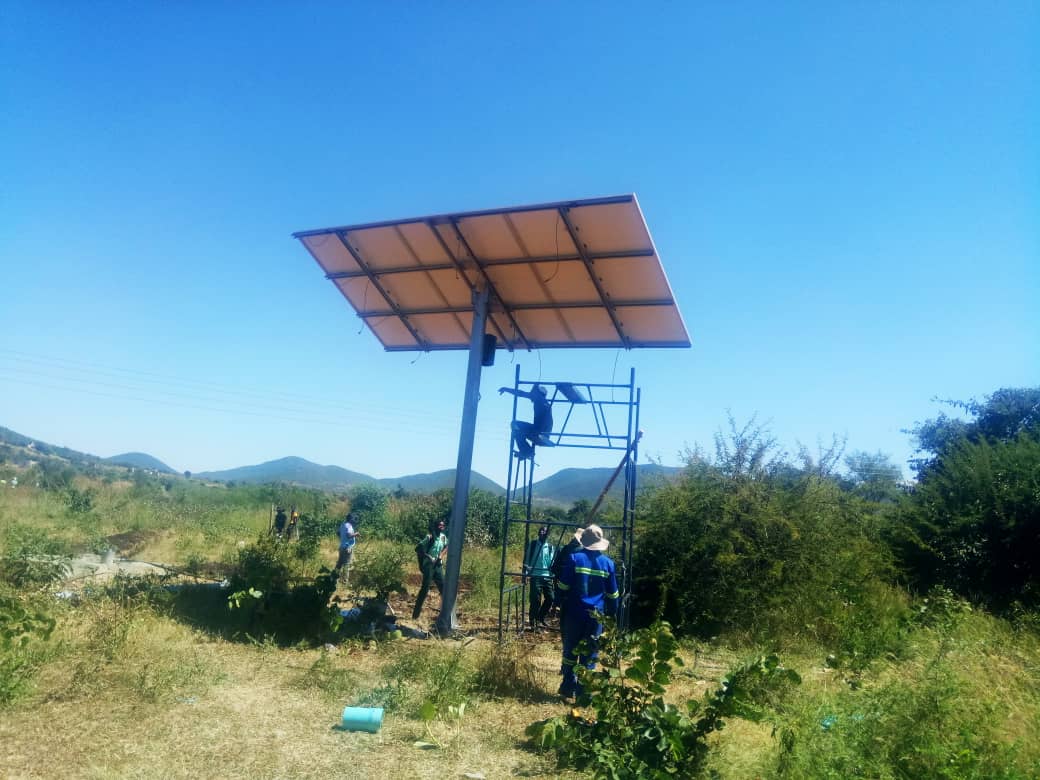
Recently, one of the local schools in the district (Makaha Secondary School) had a solar water pump system installed in its premises by a Bulawayo based irrigation and water reticulation company, Forster Irrigation ending teachers and school children’s misery of going through the trouble of dying heavy boreholes and going far places in search of safe water to drink.
“This initiative is benefiting us as school children because we do not have to go to the borehole, which is a bit far in search of water and also it helps in maintaining hygiene like student washing their hands after using the toilet and the provision of safe water to drink, unlike the dirty water we used to drink from shallow wells, ” said a form 4 student from the school.
“Also we can now do our Agricultural projects easily without having to look for gardens located near water reservs, which are usually far from school and can result in teachers losing control over some children who end up running away from lessons,” added another student.
According to foster irrigation the development’s main aim is to provide the community and school children with nearby safe and clean water.
“The main point of the whole system is to supply safe drinking water to the community, school and clinic opposite the school. We noticed that before water was being drawn from a borehole drilled on a shallow well, making the water very unsafe to drink, but now we drilled a borehole 65 metres deep and provided tanks to ensure the provision of safe water to prevent borne diseases such as cholera and it is also time saving and convenient to community members.
“Our services also provide employment for the people living in the community, for instance the need for guards, however, the biggest challenge is organising and mobilising community members to come and work and help us in installing the tanks, solar stands and gathering them up to put in their manual labour and I think this is being caused by resistance to change on the side of community members, when a new thing comes yet the people are used to a certain way of doing things there is a possibility of them resisting. The programme is quite new to them so with any new development there is a certain level of resistance.
“The only recommendation is to appraise people that the system is a much better than the old ones of using boreholes and also call upon other NGOs to come and make this dream come true to communities where water is scarce,” said one of the company’s members.
The initiative supports the emancipation of young boys and girls, making their learning much more bearable and flexible.
Apart from just making education easier, the move is a step towards the elimination of the rural-urban divide.
Also, Non-governmental Organisations have played quite a significant role in providing affordable education for both primary and secondary school children in Mudzi.
Quite a number of children go to school through the Basic Education Assistance Module (BEAM) and the Campaign for Female Education (CAMFED)’s support.
Donors have also contributed to the infrastructural improvement of most of the schools in the district’ s communities, while some also received electricity and computers to align their education system to education 5.0. However, ignorance among other economic factors continue to affect the literacy levels of children in Mudzi.
“Delivery of education service ensures that education is accessible in remote areas…and somehow the infrastructure helps in teacher retention. However, the support rendered in terms of infrastructure, textbooks and school furniture, does not correspond with pass rate, the pass rate remain as low as 5%-20% because there are other factors such as teacher renumeration and child absenteeism due to economic factors, which directly and indirectly affects the education system in Zimbabwe as a whole,” a local developer added.
Meanwhile, the Ministry of Primary and Secondary Education (MoPSE) in collaboration with the Ministry of Health and Child Care (MoHCC) recently put in place a systematic disease surveillance procedure which requires daily screening of all learners and staff during the school term, in all schools to prevent the spread of COVID-19 especially as the country is approaching the winter season.
The move is part of government efforts to provide conducive learning environments for children in all schools across the country regardless of their geographical locations.
“Our schools have become a necessary barometer for detection and management of COVID-19 nationwide. As guided by Standard Operating Procedures against COVID-19, every school is linked to a local health facility, through which any learner or member of staff who shows any possible COVID-19 symptoms is immediately referred to the Ministry of Health and Child Care’s Rapid Response Team.
“Furthermore, coordinated prevention and management of COVID-19 at all learning institutions in Zimbabwe have been developed and disseminated to all schools, and are supported by ongoing training activities. The full effectiveness of these measures can only be realised through complementary health promotion efforts within families,” said the ministry.
The Ministry urged all schools should strongly reinforce health promoting behaviours like conducting consistent daily temperature checks, maintaining thermometers used for screening learners in good working order at all times, as well as physical and social distancing, consistent and proper wearing of clean face masks, regular and correct handwashing and cleaning of schools, and proper waste disposal.
Community Development is a process where community members come together to take collective action and generate solutions to common problems.
Therefore, it directly impacts the quality of life of the people in a community. Developing the community includes projects like libraries, schools, and parks, and includes providing care and resources for the elderly, homeless, and at-risk youth.
Education is possibly the most important component because it’s more than just preparing for a job; “it involves learning to be a responsible citizen and community member, building strong social and emotional skills, sparking curiosity and a passion for learning, developing physical skills and health.
References