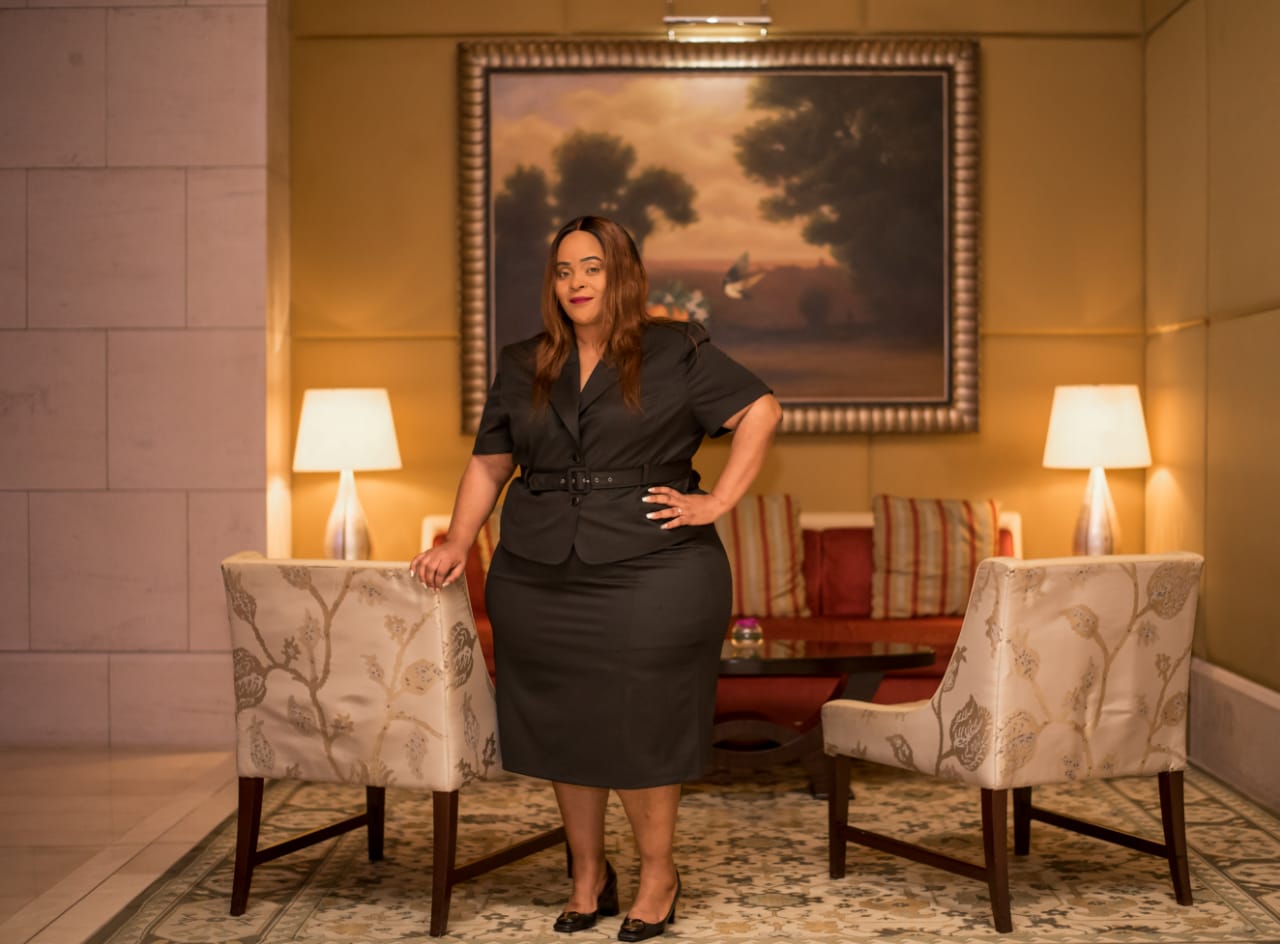

Outspoken Dubai based human rights activist and aspiring female president of Zimbabwe Democratic and Economic Freedom Party (ZDEFP) Edith Chibhamu has hit out at the Emmerson Mnangagwa led government over a patently blind eye on the continuous deterioration of the social services and governance in the country.
In a blunt condemnation of the Mnangagwa administration, Chibhamu blasted the Mnangagwa for poor governance and social services department for failing to execute its mandatory role of catering for the poor but rather choosing to side with the elite group.
“We are on our own. The poor have remained poor because of these so called elites that have continued to burrow into their pockets without shame” Chibhamu said
“Following the resurgence of Covid-19 infections in the country, Mnangagwa and his administration announced a list of lockdown measures set to run for 30 days and another 14 days.The measures included a ban on informal businesses, a 6pm-6am national curfew, and ban on international travel by land transport.
Chibhamu said before imposing a lockdown, the government should have made a plan to cushion the poor who live from hand to mouth daily through vending and other informal businesses.
Although Chibhamu admits that lockdowns were a recommended global tool used to contain the continued spread of Covid-19, she however took a swipe at Zimbabwean authorities for a copy and paste job without pausing to consider the country’s different circumstances.
Mnangagwa’s officials have failed to account for the US$3b Command Agriculture budget, much of which enriched ruling party cronies such as Kudakwashe Tagwirei.
By using the COVID-19 crisis to issue a fiat banning public passenger transport companies, Mnangagwa cleared the decks for the government and Tagwirei-controlled Zimbabwe United Passenger Company for further profiteering via inflated procurement contracts.
Reports emerged last year about inflated government contracts awarded to companies to supply personal protective equipment and coronavirus testing kits worth tens of millions of US dollars. Some of these contracts are linked to a company connected to the President’s son Collins Mnangagwa.
Despite hiring lobbyists in Washington DC, international views of the Mnangagwa government are overwhelmingly negative. Almost none of the promised US$10bn in foreign investment has materialised.
Mnangagwa told us the voice of the people is the voice of God. He didn’t listen to either. Now he faces a people’s power movement.
There is no dispute about the depths of political, ethical and economic degradation of Zimbabwe after two and a half years of Emmerson Mnangagwa’s presidency.
No dispute because his own ministers and advisors publicly admit the state is on the brink of collapse due mainly to the grand corruption of the country’s ruling class. Worse still for Mnangagwa, many junior officers share the view that he and the predatory elite that he leads are steering the country into the abyss.
It is this message from the junior officers and the ranks of the military that is unsettling the generals, with whom Mnangagwa has shared the spoils of state capture. Although Mnangagwa and his deputy General Constantino Chiwenga were once seen as inseparable allies, the looming failure of the Zimbabwean state is sharpening the elite’s sectional and divergent interests.
By allowing corruption to rip through the system, from illegal gold and diamond exports to arbitrage between the US dollar and the latest version of Zimbabwe’s currency, Mnangagwa has undermined his own praetorian guard.
Hollowed out and looted, the state can no longer look after its own soldiers and police, and their families; let alone address the spectre of mass starvation and a public health emergency haunting over half of Zimbabwe’s 16 million people.
Last year, Finance Minister Mthuli Ncube wrote to the International Monetary Fund (IMF) lamenting that the “…economy could contract by 15-20% during 2020 with very serious social consequences. Already 8.5 million Zimbabweans (half the population) are food insecure.”
So bad is the situation, wrote Ncube, that Zimbabwe’s state could implode and threaten security in neighbouring states. He warns: “… the global pandemic will take a heavy toll on the health sector with many lives lost and raise poverty to levels not seen in recent times, including worsening food security.”
Mnangagwa and his military allies insisted they had organised the overthrow of Robert Mugabe in 2017 to stamp out corruption, to open the country for business and hold free and fair elections. On their own admission they have failed.
Shingi Munyeza, a kingpin of Zimbabwe’s business class and a member of Mnangagwa’s advisory council also waged in describing how the government was leading Zimbabwe into perdition: “These are the last kicks of a dying horse, of a system that is evil and corrupt… our state is captured by cartels who are operating with those who are in power, strong men, to the detriment of the rest of us,” he says in a remarkable indictment of a government he had worked with closely.
“They move from state capture to state abuse where citizens are being abused, physically, emotionally …. There is nothing that passes on to the ordinary man or ordinary woman and then it moves on to state failure which I believe is where we are heading now […].”
A senior pastor in the Faith Ministries Church as well as a wealthy businessman, Munyeza started prophesying the fall of Mnangagwa’s government over social media. It resonated strongly with the military, some of whose top officers are said to be backing him.
Why sound the alarm bells now after years of elite plunder of Zimbabwe? Some, at least, in the predatory elite are seriously rattled by the prospect of state collapse and their own survival in a new order.
If anything, economic conditions in Zimbabwe are currently worse than those in Sudan under al- Bashir. At least Sudan’s regime had some regional sponsors such as Saudi Arabia and the United Arab Emirates. Mnangagwa’s government evinces no regional solidarity.
South Africa, whose ministers worry about the worsening instability and grand corruption north of the Limpopo, make ritualistic complaints about the unfairness of sanctions that bar Zimbabwe from borrowing from the IMF.
In truth, President Cyril Ramaphosa is concerned about Harare’s debt mountain with South Africa and a growing tide of Zimbabweans heading south to compete in the local labour market.
At home in Zimbabwe, the continuous profiteering and nepotism in the awarding of state contracts while half the country faces what the UN euphemistically calls ‘food insecurity’, tells people that the Mnangagwa government has reached a low level of morality. Some of his oldest allies now fear popular retribution, and they can’t rely on the fracturing security services to protect them.
Activists, journalists and opposition politicians who point out this waning morality in our country under Mnangagwa’s rule are beaten, tortured and killed. As the European colonialists found out, Zimbabweans are slow to anger but when they decide to fight, they become an implacable force.
Three years down the line, there is now consensus at least that Mnangagwa has failed.
Internal rivalries inside Zanu PF are an open secret with new factions that pit Mnangagwa against his Deputy Constantine Chiwenga.
Most important is the shift among Zimbabweans who can no longer tolerate the Mnangagwa-Zanu PF regime and see no prospect of its reform. Its combination of grand corruption, serial incompetence and brutal repression are beyond redemption.
To make matters worse, is the pomposity, arrogance and epic hypocrisy of the ruling elite, founded on their belief that they can always bludgeon their way out of trouble, thanks to the blind loyalty of Zimbabwean soldiers and police. A reality check on that front is about to confront Mnangagwa and his allies head on.
Edith Chibhamu is Dubai based business woman, human rights activist and aspiring President for Zimbabwe Democratic and Economic Freedom Party (ZDEFP). She can be contacted on Instagram: @official_queendee