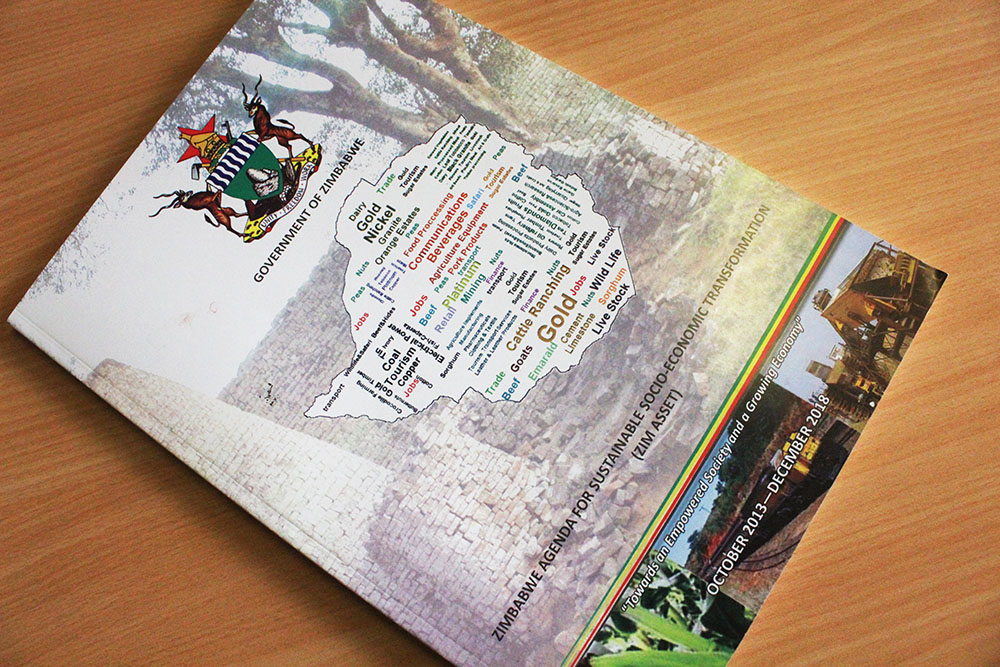

Malvern Mkudu In the executive Summary of the Zim Asset policy document, its architects claim that the policy was crafted to ‘achieve sustainable development and social equity anchored on indigenisation, empowerment and employment creation.’ These are expected to be driven through the exploitation of the country’s natural resources. Zim Asset proposes a cluster based approach towards development by identifying key strategic clusters that include food security and nutrition, social services and poverty eradication, infrastructure and utilities and Value Addition and Beneficiation. The economic blue print was conceived at a time when international lending institutions such as the World Bank and International Monetary Fund had frosty relations with the country. The policy is a delicate attempt by the ruling party to appease its supporters that voted on the merit of its empowerment policies while at the same time re-engaging the international community to invest in the country. Zim Asset promised to generate 2,256,000 million jobs, 250,000 low income houses, a growth rate of 9 percent, 310 new public schools and 300 more clinics up to 2018, but the blueprint is lagging behind. So far it has been a case of hit and miss with the IMF and World Bank insisting on a raft of changes before they can support the country’s economic recovery efforts. The government has refused to back down on its ‘radical’ indigenisation policy and has been slow in implementing cost cutting measures especially the bloated wage bill in the public service. The policy was crafted primarily to consolidate the gains of various empowerment policies that ZANU PF embarked on. This has been received well especially by small scale farmers, miners and those in the informal economy which is reportedly contributing 20% of the Gross domestic product. There is doubt on whether this informal sector which is consuming more than it’s producing will create enough jobs to induce economic activity that will achieve the projected growth levels. Since 2000 when the government embarked on the land reform programme, it claims that more than 300000 families have been resettled. It is on these successes that the government plans to build on through the indigenisation policy that has been made the cornerstone of Zim Asset. The success of this land policy is evident in the booming tobacco sector where more Black farmers are participating and have sold over $600million worth of tobacco this year alone. More cases of success are in the Dairy and poultry sectors where first family linked Gushungo Dairies and Lunar Chickens have emerged. But food security is at its most vulnerable since 1980 as the majority of the new farmers avoid the labour intensive and low paying cereal farming to concentrate on cash crops. Since 2001, the country has moved from being an exporter to an importer of grain with the country currently importing 150 000t of maize from South Africa. Despite Zim Asset pledging to strengthen the food security situation of the country, the mismanagement of key parastatals such as the GMB under government’s watch casts doubts on whether this objective will be achievable. Inequality has risen even though the policy pledges to eradicate poverty and empower the majority of Black Zimbabweans as thousands have lost employment through massive company closures while the new farmers have failed to absorb labourers that previously worked on repossessed farms. Although wealth has exchanged hands from Whites to Blacks income and wealth inequality has increased in Zimbabwe. While ordinary people no longer perceive inequality as existing between Black and White, many now view it as existing between the ‘povo’ and the politically connected. It is clear that more Black people have been disempowered through the loss of jobs and income than the very few who benefitted through the amassing of land. Soon after elections the government evicted over 900 families from a Mazoe farm and more continue to lose their farms at the behest of powerful party officials in what seems to be a reversal of the benefits that Zim asset pledges to consolidate. Zim Asset has not given resettled new farmers security of tenure by giving them title deeds. Without security, financial institutions are not willing to lend to the new farmers and this will have a knock on effect on the food security situation of the country. There is also no clarity as to the security of tenure that 99 year leases provide, and banks are still sceptical about accepting them as collateral. Empowering these new farmers through secure land tenure would weaken the government’s political stranglehold on them. It can be argued that the government wants them to remain grateful tenants for political expediency. Until the economic blue print addresses this issue, many farms will remain unproductive as the risk of investing in them is too high. It is therefore unclear how the policy will empower Black people when the thousands who were resettled risk losing their land at the whims and caprices of the government. According to the Zimstat Poverty, Income, Consumption and Expenditure Survey of 2011-2012 over 60% of Zimbabweans are living in abject poverty while the few that are employed earn below the poverty datum line, currently pegged at US$560. The economic blue print does not spell out its intentions on social security and how it plans to insulate the poorest from economic hardship. Ordinary Zimbabweans are unable to access basic services such as electricity and water. Still the government has introduced electricity meters and is mulling introducing water meters effectively ensuring that any subsidies it used to pay for the vulnerable to access basic commodities are done away with. Health care and especially tertiary education is now beyond the reach of many Zimbabweans. Moreover, the policy does not propose a sustainable social welfare plan for the most vulnerable of our society. Pensioners are currently earning a paltry $40 while those who recklessly invested the pension funds in failed banks rake in huge salary perks. Vice President Mujuru’s revelations that Zim Asset is a long term economic blue print whose fruits would only be enjoyed in 40 years time has placed further doubt and confusion on whether the policy has the necessary attributes to solve immediate economic pressures. Zim Asset proposes what it calls ‘quickwins’ to kick start the economy but this has not materialised. The ‘quickwins ‘have either not been implemented or they have failed to yield immediate results. $27 billion is required to fund this economic policy and foreign investors who are expected to supply 92.5 % of the funding are sceptical about investing in the country. Despite pleas for funding by Finance Minister Patrick Chinamasa the international community including friendly countries such as China have not yielded. It is clear that Zim Asset has thus far failed to lure international financial institutions despite the ongoing deliberations between the Finance Ministry and IMF and World Bank officials. The country is a high risk investment destination mainly due to corruption, an unclear indigenisation law and a tendency by the government to ignore the rule of law. Value addition and beneficiation underpinned by the exploitation of the country’s mineral resources is unlikely to work unless if the government pays attention to corruption and incompetence in contract negotiations. The partnerships with private players in Marange have failed with the foreign private companies engaged for partnerships not delivering on their pledges to engage local communities in the exploitation of natural resources. Already the government has gone cold on the issue of Community Share Funds that were set up to empower local communities that have precious minerals. None of the mining companies have delivered on their promises to fund these Trust Funds while parliament has also been told that money was looted in these share funds. The policy is therefore failing to deliver in what it lists as its key result areas. Its gains are in danger of being reversed if it fails to arrest the immediate economic problems affecting the country. It is safe to conclude that Zim Asset is a document in contradiction with the actions of its architects. While it claims to be a pro-poor policy in pursuit of economic equality and transformation, the government’s actions are capitalistic. Much as it is a visionary economic blue print that could achieve economic transformation and equity in the future, it lacks pragmatism in addressing the immediate economic problems facing Zimbabweans. Zim Asset is a policy full of good intentions but fails to correspond to reality. Malvern Mkudu writes in his personal capacity. He is available on malvernmkudu@yahoo.com